Breast Pump: What It Is and When You Might Need One
 Category Category | Feeding |
|---|

Medically reviewed by pediatrician Alexandra Zglavosiy
A breast pump helps express milk and maintain lactation when needed. It’s useful during separation from your baby, engorgement, or for building a milk stash. Manual models work well for occasional use, while electric pumps suit regular pumping. Always clean and store milk properly. Avoid used pumps — they may carry bacteria.


sprouty
Sleep, feeding, and milestones in one app


Quick takeaways
- A breast pump helps maintain breastfeeding when you're away from your baby, experiencing engorgement, or building a milk stash. Use a manual pump for occasional use, and an electric one for regular pumping.
- Before the first use, sterilize all parts and begin with the lowest suction setting to avoid discomfort.
- Store milk in small portions: up to 4 days in the fridge, up to 6 months in the freezer. Never thaw in the microwave — use the fridge or cold running water.
- Wash all parts with warm soapy water after each use. Sterilize 1–2 times a day.
- Avoid used pumps — even with careful cleaning, they may harbor bacteria.
Not every mom needs a breast pump — but it can be helpful in many situations
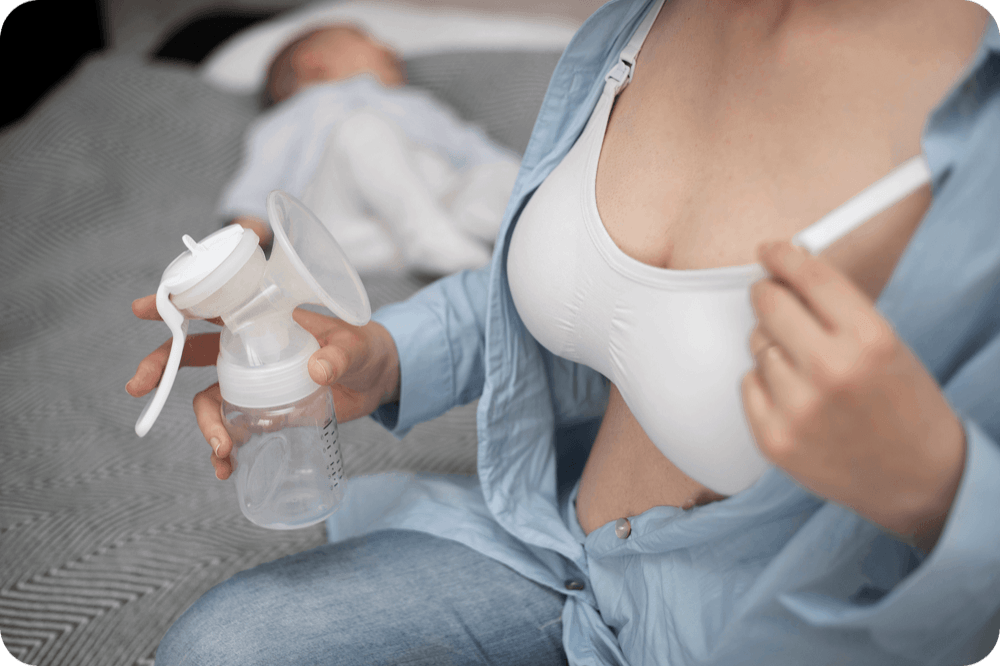
A breast pump is a device that mimics a baby’s sucking to help express milk. It includes a flange (placed on the breast) and a mechanism that creates gentle vacuum pressure to stimulate milk flow.
You might need one if:
- You’ll be away from your baby — returning to work, running errands, or leaving baby with a caregiver.
- You’re dealing with engorgement (clogged ducts) — if your breasts are too full and your baby can’t empty them, pumping relieves pressure and discomfort.
- You’re experiencing oversupply (hyperlactation) — pumping can ease fullness.
- Your baby is premature or has trouble latching — pumping ensures baby still receives your milk.
- You’re separated from your baby — hospitalization or other temporary separation.
- You want to build a milk stash — for times when you’re away.
- You’re traveling — sometimes it’s hard to find a quiet place to nurse on the go.
There are manual and electric breast pumps
Each has pros and cons.
Manual (hand-powered)
- No electricity required, less expensive
- Requires hand effort and time
Electric (battery or plug-in)
- Automatic suction, great for frequent pumping
- Some models mimic baby’s natural sucking
- More expensive, may be noisy
If you’ll only pump occasionally — a manual pumpmay be enough. If pumping is frequent, an electric modelis more convenient.
It’s best to buy your own pump. Pediatricians don’t recommend borrowing one, renting, or buying used — they may carry bacteria even if cleaned thoroughly.
How to pump safely and effectively
- Choose a calm, comfortable space. Relax, sip a warm drink, think about your baby — this can help with letdown.
- Position the flange snugly on your breast to prevent leakage and discomfort.
- If using an electric pump, start at the lowest suction level. Increase gradually if needed.
- Pump based on your goal:
- For relieving fullness: pump until comfortable
- For replacing a feeding: pump until the breast feels empty
- Store milk properly:
- Fresh milk in the fridge (up to 4 days at ≤ 39°F / 4°C)
- Freeze for up to 6 months in sterilized containers
- Sterilize the pump before each use. Keep all parts clean.
To safely thaw milk and preserve nutrients, place it in the fridge or under cold running water. Never thaw in hot water or the microwave.
Clean the pump regularly
- After each use, wash all parts with warm water and mild soap.
- Sterilize once or twice a day (especially in early months). Use boiling water or a steam sterilizer.
- Store dry, in a clean container to avoid contamination.
Frequently Asked Questions About Breast Pumps
Why might I need a breast pump?
Often, a breast pump is useful when you need to express milk or maintain lactation. It may help during temporary separation, engorgement, oversupply, travel, building a milk stash, or when your baby is premature or not yet able to latch and nurse effectively.
Which breast pump is better — manual or electric?
Usually, a manual pump is better for occasional pumping, while an electric pump is more convenient for regular use. Manual pumps are cheaper and don't need electricity, but take more effort and time. Electric pumps create automatic rhythmic suction, though they may be more expensive and noisy.
How should I store expressed breast milk?
Freshly expressed milk should be stored in small portions in sterile containers. It can stay in the fridge for up to 4 days at 4 °C / 39 °F or below, and in the freezer for up to 6 months. Thaw it in the fridge or under cold running water, never in hot water or a microwave.
How do I use and clean a breast pump safely?
It's best to sterilize pump parts before use and keep them clean. After each pumping session, wash all parts with warm soapy water. Sterilize them 1–2 times a day, especially in the first months, and store dry parts in a clean container to prevent contamination.
With care
Our articles are based on evidence-based medicine and reviewed by pediatricians. However, they do not replace a consultation with your doctor. Every child is unique — if you have any concerns, please consult a medical professional.
sprouty
Sleep, feeding, and milestones in one app
Sources
- Eglash A, Simon L; Academy of Breastfeeding Medicine. ABM Clinical Protocol #8: Human Milk Storage Information for Home Use for Full-Term Infants, Revised 2017. Breastfeed Med. 2017 Sep;12(7):390-395. doi: 10.1089/bfm.2017.29047.aje. Epub 2017 Jun 29. Erratum in: Breastfeed Med. 2018 Jul/Aug;13(6):459. doi: 10.1089/bfm.2017.29047.aje.correx. PMID: 29624432. https://pubmed.ncbi.nlm.nih.gov/29624432/
- “Once Baby Arrives (Food Safety for Moms-to-Be)”, U.S. Food and Drug Administration, https://www.fda.gov/food/people-risk-foodborne-illness/once-baby-arrives-food-safety-moms-be. Accessed 01 Apr. 2026.
- “What to Know When Buying or Using a Breast Pump”, U.S. Food and Drug Administration, https://www.fda.gov/consumers/consumer-updates/what-know-when-buying-or-using-breast-pump. Accessed 01 Apr. 2026.
- U.S. Centers for Disease Control and Prevention, https://www.cdc.gov/breastfeeding/breast-milk-preparation-and-storage/handling-breastmilk.html. Accessed 01 Apr. 2026.
- “Breast Pump”, Cleveland Clinic, https://my.clevelandclinic.org/health/articles/25244-breast-pump. Accessed 01 Apr. 2026.
- Mohammed T, Aradhya AS. Breast Pump Hygiene: A Missed Opportunity in Parental Education. Indian J Pediatr. 2025 Mar;92(3):322. doi: 10.1007/s12098-024-05374-w. Epub 2024 Dec 26. PMID: 39722100. https://pubmed.ncbi.nlm.nih.gov/39722100/. Accessed 8 Apr. 2026.