How to Improve Walking Skills
 Category Category | Motor activity |
|---|

Medically reviewed by pediatrician and perinatal psychologist Polina Kizino
Babies learn to walk through play and movement — at their own pace and without gear. What helps most is a safe space at home, time barefoot, kind encouragement, and playful activities with parents. Don’t rush or compare — just enjoy every step.


sprouty
Sleep, feeding, and milestones in one app



Quick takeaways
- Most babies start taking their first steps between 9 and 18 months.
- The best thing parents can provide is a safe space and the freedom to move.
- Barefoot on the floor, chasing a ball, walking toward mom — natural stimuli work better than baby gear.
- Confidence in walking comes through repetition, trial, and error.
- Not all babies develop the same way — each child’s pace is unique.
How walking develops in babies
Walking is a complex skill that requires coordination, muscle strength, and balance. Before their first birthday, babies go through key stages: learning to sit, crawl, pull up, stand, and take supported steps. Independent walking usually appears between 10 and 18 months.
At this stage, it’s important to:
- Create a safe, open space for movement
- Support your child’s attempts to stand, take steps, and reach for toys
- Celebrate together — emotional support boosts motivation
Why barefoot is better
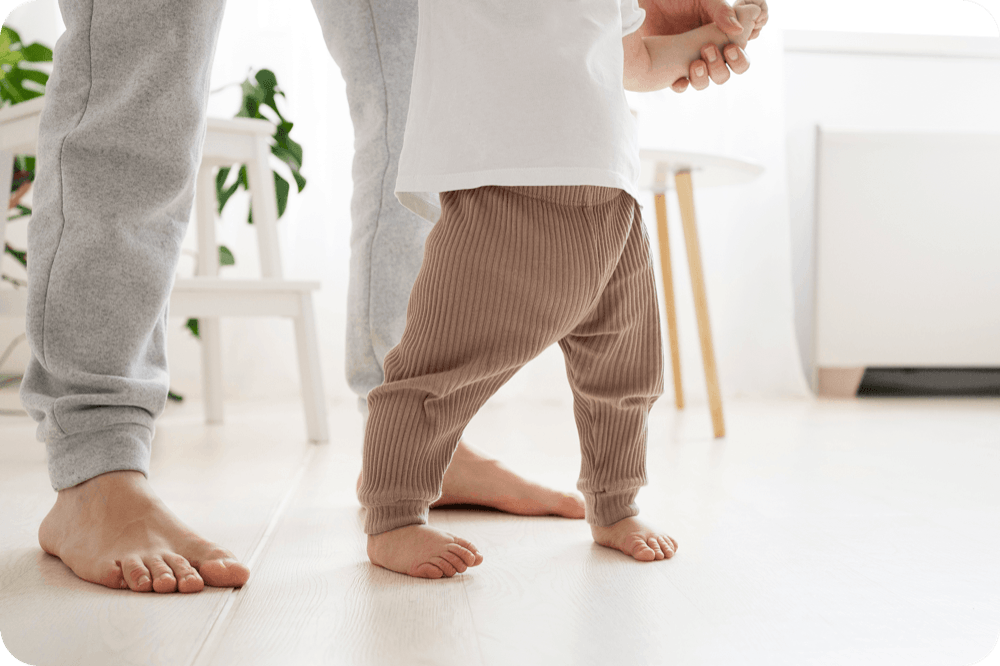
Walking barefoot on a flat, safe surface helps:
- Develop the small muscles in the feet
- Improve coordination and balance
- Provide tactile and proprioceptive input (the body’s sense of position in space)
Shoes are only needed outdoors — at home, walking barefoot or in non-slip socks is best
What doesn’t help
Despite their popularity, walkers and jumpers do not promote walking skills. In fact, they can:
- Disrupt natural movement mechanics
- Increase the risk of injury
- Delay skill acquisition
- Even lead to lower limb deformities
How to build walking skills through play
Movement is play — and play is the best training. Here’s what works:
- Hide a toy to encourage the baby to walk toward it
- Sit and stand together, practice picking things up from the floor
- Try balance activities — kneeling, stepping over small obstacles
- Play musical or active games like “come here!” or “chase me!”
A baby learns best when they’re having fun
What pace is normal
Parents often worry: “What if my child is behind?” It’s important to remember:
- Every child develops at their own pace
- A variation of up to 3 months in either direction is normal
- Progress matters most: if your baby is starting to take supported steps, the skill is developing
- If your child isn’t walking by 18 months and has no other motor milestones, talk to your pediatrician
Frequently Asked Questions About Learning to Walk
At what age do babies start walking?
Usually, first independent steps appear between 9 and 18 months, and this range is considered normal. What matters most is overall progress: sitting, crawling, pulling up, standing, and taking supported steps. Try not to compare your baby with other children.
How can I help my baby walk more confidently?
Free movement, a safe space, and play help most. Remove hazards, encourage your baby to walk toward a toy, ball, or parent, and practice sitting, standing, and stepping over small obstacles together. Walkers and jumpers are not needed and may interfere with natural movement mechanics.
Should my baby wear shoes at home?
No, at home it is better to walk barefoot or in non-slip socks. This helps develop the small foot muscles, coordination, balance, and body-position awareness. Shoes are mainly needed outdoors, where they protect the feet from cold, dirt, and injury.
When should I talk to a pediatrician about walking?
Talk to your pediatrician if your child is not walking independently by 18 months. It is especially important to ask for advice if there is also no progress in other motor skills, such as pulling up, standing, taking supported steps, or learning new movements.
With care
Our articles are based on evidence-based medicine and reviewed by pediatricians. However, they do not replace a consultation with your doctor. Every child is unique — if you have any concerns, please consult a medical professional.
sprouty
Sleep, feeding, and milestones in one app
Sources
- Adolph, K.E. and Tamis-LeMonda, C.S. (2014), The Costs and Benefits of Development: The Transition From Crawling to Walking. Child Dev Perspect, 8: 187-192. https://doi.org/10.1111/cdep.12085. Accessed 7 May 2026.
- and de Onis, M. (2006), WHO Motor Development Study: Windows of achievement for six gross motor development milestones. Acta Pædiatrica, 95: 86-95. https://doi.org/10.1111/j.1651-2227.2006.tb02379.x. Accessed 7 May 2026.
- Ariel Sims, Thitphalak Chounthirath, Jingzhen Yang, Nichole L. Hodges, Gary A. Smith; Infant Walker–Related Injuries in the United States. Pediatrics October 2018; 142 (4): e20174332. 10.1542/peds.2017-4332. https://publications.aap.org/pediatrics/article-abstract/142/4/e20174332/37420/Infant-Walker-Related-Injuries-in-the-United. Accessed 7 May 2026.
- Infant development: Milestones from 10 to 12 months, Mayo Clinic, https://www.mayoclinic.org/healthy-lifestyle/infant-and-toddler-health/in-depth/infant-development/art-20047380. Accessed 7 May 2026.
- Are Infant Walkers Safe? Here’s What New Parents Need to Know, Cleveland Clinic, https://health.clevelandclinic.org/are-infant-walkers-safe. Accessed 7 May 2026.