Creating a Safe and Comfortable Nursery
 Category Category | Nursery and objects |
|---|

Medically reviewed by pediatrician and perinatal psychologist Polina Kizino
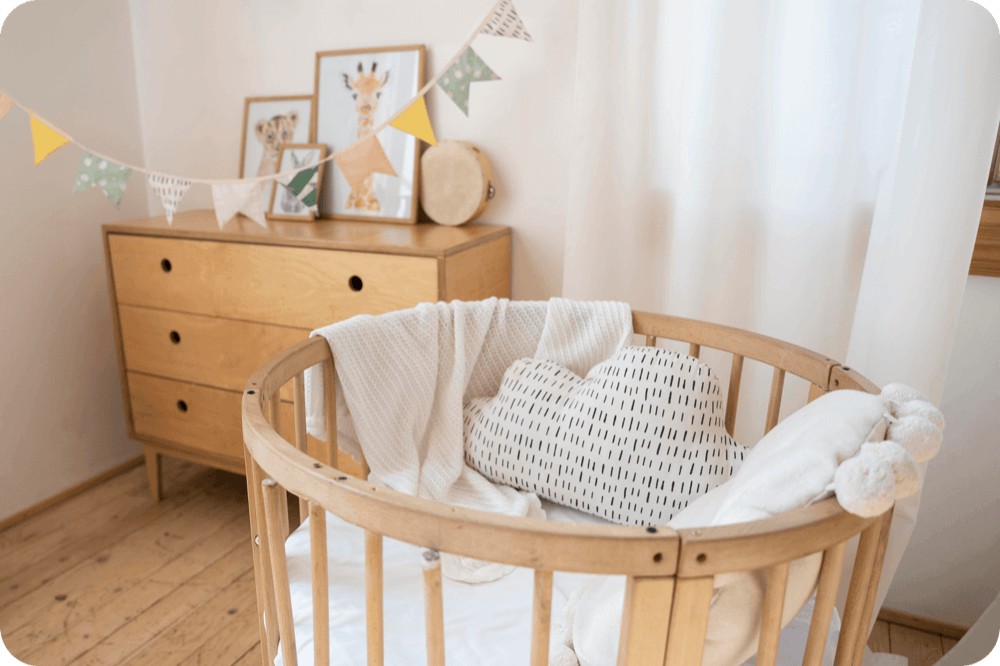
The nursery should be comfortable, safe, and supportive for your baby. Keep the temperature between 18–22 °C (64–72 °F), and humidity at 40–60%. Use soft lighting, especially in the evening and at night. Ventilate the room 2–3 times a day. The crib should contain only a mattress — no bumpers, pillows, or toys. Avoid antiseptics and air fresheners — natural microbes support immunity.


sprouty
Sleep, feeding, and milestones in one app



What’s inside
Quick takeaways
- Climate: Maintain a temperature of 18–22°C and humidity of 40–60%. Use a humidifier during heating seasons.
- Lighting: Diffuse natural light during the day, warm dimmed light in the evening, and a soft nightlight at night.
- Sleep area: Use a firm mattress with no pillows, blankets, or toys. Crib slats should be spaced no more than 6 cm apart. Avoid crib bumpers—they increase the risk of suffocation and Sudden Infant Death Syndrome (SIDS).
- Ventilation: Air out the room 2–3 times a day. Avoid drafts. In hot weather, keep windows open with a mosquito net.
- No need for sterility: Moderate exposure to germs strengthens your child’s immune system.
Maintain Ideal Temperature and Humidity
Babies are sensitive to temperature changes, so a stable environment is crucial:
- Temperature: 18–22°C. Overheating can cause sweating and discomfort, while cold increases the risk of illness.
- Humidity: 40–60%. Dry air may lead to dry mucous membranes and breathing issues. Use a humidifier in winter.
Lighting Matters
A newborn’s eyes are sensitive to bright light:
- Daytime: Use natural, diffused light. Avoid direct sunlight.
- Evening: Opt for warm, dim lighting to help your baby relax before sleep.
- Night: Use a soft nightlight for nighttime feedings or diaper changes without turning on bright lights.
Ensure a Safe Sleep Space
The crib must meet safety standards:
- Mattress: Firm and flat. Avoid pillows, stuffed animals, or loose bedding.
- Slat spacing: No more than 6 cm between slats to prevent trapping.
- No crib bumpers: They pose a suffocation risk and are linked to SIDS.
Ventilate the Room Properly
Fresh air prevents overheating and dryness:
- Open windows 2–3 times daily, ensuring the crib isn’t in a draft.
- In summer, leave windows open with a mosquito net to protect against insects.
Childproof the Room
Create a hazard-free environment:
- Remove small objects or choking hazards from the baby’s reach.
- Cover electrical outlets and pad sharp furniture edges.
- Secure heavy furniture (e.g., dressers) to walls to prevent tipping.
- Avoid air fresheners or strong cleaners—they can irritate your baby’s airways.
- Skip excessive sanitizing: mild exposure to germs boosts immunity.
Heating and Cooling Tips
- Safe heating: Use radiators or central heating. Avoid placing heaters near the crib.
- Cooling: Use air conditioning or fans, but ensure airflow isn’t directed at the baby.
- Always ventilate the room when using heating/cooling devices.
With care
Our articles are based on evidence-based medicine and reviewed by pediatricians. However, they do not replace a consultation with your doctor. Every child is unique — if you have any concerns, please consult a medical professional.
sprouty
Sleep, feeding, and milestones in one app
Sources
- “Getting Ready for Your Newborn at Home”, Children’s Hospital of Philadelphia, https://www.chop.edu/primary-care/getting-ready-your-newborn-home. Accessed 2 Apr. 2026.
- “Crib Safety Tips”, United States Consumer Product Safety Commission, www.cpsc.gov/safety-education/safety-guides/cribs/crib-safety-tips. Accessed 2 Apr. 2026.
- Engel M, Ahlers-Schmidt CR, Suter B. Safe Sleep Knowledge and Use of Provided Cribs in a Crib Delivery Program. Kans J Med. 2017 Aug 30;10(3):1-8. PMID: 29472971; PMCID: PMC5733451. https://pmc.ncbi.nlm.nih.gov/articles/PMC5733451/. Accessed 7 Apr. 2026.
- Recommendations for safe sleeping environments for infants and children. Paediatr Child Health. 2004 Nov;9(9):659-672. doi: 10.1093/pch/9.9.659. PMID: 19675857; PMCID: PMC2724135. https://pmc.ncbi.nlm.nih.gov/articles/PMC2724135/. Accessed 7 Apr. 2026.
- Rachel Y. Moon, Rebecca F. Carlin, Ivan Hand, THE TASK FORCE ON SUDDEN INFANT DEATH SYNDROME AND THE COMMITTEE ON FETUS AND NEWBORN; Sleep-Related Infant Deaths: Updated 2022 Recommendations for Reducing Infant Deaths in the Sleep Environment. Pediatrics July 2022; 150 (1): e2022057990. 10.1542/peds.2022-057990. https://publications.aap.org/pediatrics/article/150/1/e2022057990/188304/Sleep-Related-Infant-Deaths-Updated-2022. Accessed 7 Apr. 2026.