How to Choose a Baby Crib
 Category Category | Sleep |
|---|

Medically reviewed by pediatrician Alexandra Zglavosiy
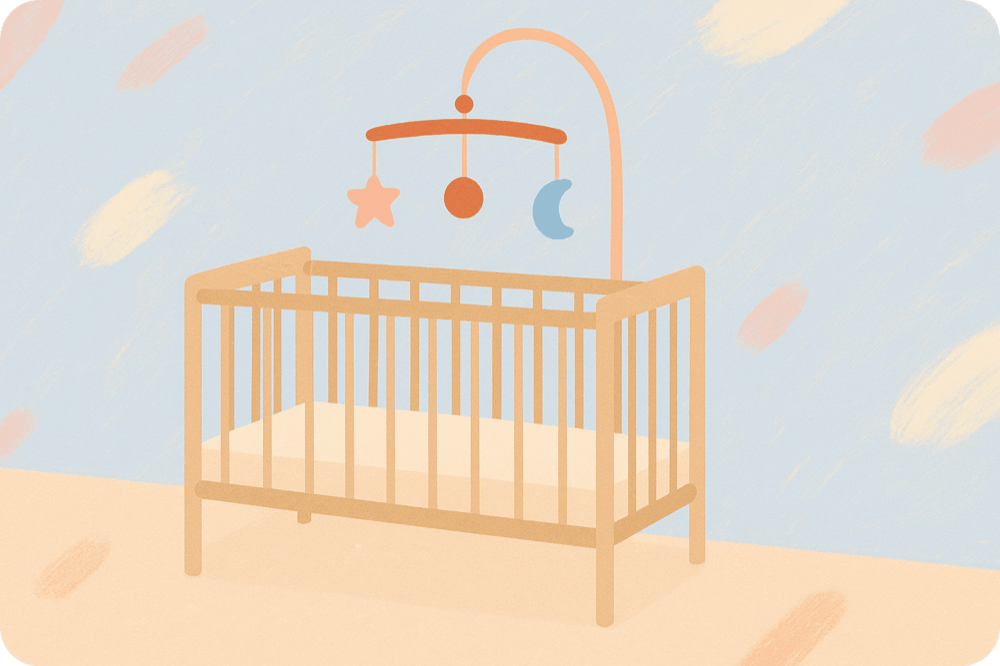
A baby’s crib should be both comfortable and safe. Choose natural wood, slats no wider than 6 cm, sides at least 50 cm high, and a firm mattress with no gaps. A bassinet works for 5–6 months; a classic or convertible crib lasts longer. Pillows, toys, and non-breathable bumpers should not be used.


sprouty
Sleep, feeding, and milestones in one app



Quick takeaways
- Classic crib or transformer — ideal for long-term use (up to 3–5 years). A bassinet suits the first 5–6 months but is quickly outgrown.
- Safety first: Slats no wider than 6 cm, sides at least 50 cm tall.
- Firm mattress with no gaps around edges. No pillows/toys — reduces SIDS risk.
- Choose natural wood cribs with water-based finishes.
- Useful extras: Adjustable base (for growth) and removable side (for co-sleeping).
Types of Cribs
- Classic wooden crib: Standard fixed sides. May include rocking or pendulum mechanisms.
- Bassinet: Compact for newborns, typically used up to 6 months.
- Co-sleeper: Attaches to parents’ bed for nighttime feedings.
- Transformer crib: Converts into a sofa, playpen, or desk. Space-consuming but practical.
- Playpen-crib: Portable, foldable for travel.
- For long-term use: Classic or transformer. For newborns: bassinet/co-sleeper.
Safety Checklist
- Slat spacing: ≤6 cm to prevent entrapment.
- Side height: ≥50 cm to prevent falls.
- Locking mechanism: Secure wheels/pendulum if present.
- Mattress: Snug fit with no gaps.
- No sharp edges/decor that could injure.
- No pillows, blankets, soft toys, or non-breathable bumpers — SIDS risk.
- Avoid drop-side rails due to malfunction risks.
Best Materials
Natural wood (beech, birch, oak) with water-based, non-toxic finishes.
Durable, hypoallergenic, and safe.
Optional Features
- Pendulum mechanism: For rocking (optional)
- Adjustable base: Lowers as baby grows
- Removable side: For co-sleeping setups
- Storage drawers: For diapers and baby items
Frequently Asked Questions About Choosing a Baby Crib
What crib is best for a newborn?
Usually, a classic crib or a convertible crib is best for long-term use. These options can last up to 3–5 years, and a convertible crib may later become a sofa, playpen, or desk. For the first months, a bassinet or co-sleeper is convenient, but a bassinet is usually outgrown by 5–6 months.
What should I check when choosing a safe crib?
Start by checking the crib's measurements and structure. Slats should be no more than 6 cm apart, sides should be at least 50 cm high, and the mattress should be firm with no gaps around the edges. If the crib has wheels or a rocking mechanism, they must lock securely.
What can be placed in a newborn's crib?
A newborn's crib should contain only a firm mattress and a tightly fitted sheet. Pillows, blankets, soft toys, and non-breathable bumpers are not needed and may increase the risk of suffocation and SIDS. Until 12 months, these items should not be used for sleep.
What crib material is best?
Natural wood is usually the best choice, such as beech, birch, or oak. It is durable, hypoallergenic, and safe for babies. Check that the finish is water-based, non-toxic, and has no strong smell. The crib should also have no sharp corners or decorative parts that could injure the baby.
Why should drop-side cribs be avoided?
Drop-side cribs are best avoided because the mechanism can malfunction. This may create a risk of the baby falling or getting into an unsafe position. Safer options have fixed sides, a stable frame, and reliable locks on any moving parts, such as wheels or a rocking mechanism.
With care
Our articles are based on evidence-based medicine and reviewed by pediatricians. However, they do not replace a consultation with your doctor. Every child is unique — if you have any concerns, please consult a medical professional.
sprouty
Sleep, feeding, and milestones in one app
Sources
- “Getting Ready for Your Newborn at Home”, Children’s Hospital of Philadelphia, https://www.chop.edu/primary-care/getting-ready-your-newborn-home. Accessed 2 Apr. 2026.
- “Crib Safety Tips”, United States Consumer Product Safety Commission, www.cpsc.gov/safety-education/safety-guides/cribs/crib-safety-tips. Accessed 2 Apr. 2026.
- Engel M, Ahlers-Schmidt CR, Suter B. Safe Sleep Knowledge and Use of Provided Cribs in a Crib Delivery Program. Kans J Med. 2017 Aug 30;10(3):1-8. PMID: 29472971; PMCID: PMC5733451. https://pmc.ncbi.nlm.nih.gov/articles/PMC5733451/. Accessed 7 Apr. 2026.
- Recommendations for safe sleeping environments for infants and children. Paediatr Child Health. 2004 Nov;9(9):659-672. doi: 10.1093/pch/9.9.659. PMID: 19675857; PMCID: PMC2724135. https://pmc.ncbi.nlm.nih.gov/articles/PMC2724135/. Accessed 7 Apr. 2026.
- Rachel Y. Moon, Rebecca F. Carlin, Ivan Hand, THE TASK FORCE ON SUDDEN INFANT DEATH SYNDROME AND THE COMMITTEE ON FETUS AND NEWBORN; Sleep-Related Infant Deaths: Updated 2022 Recommendations for Reducing Infant Deaths in the Sleep Environment. Pediatrics July 2022; 150 (1): e2022057990. 10.1542/peds.2022-057990. https://publications.aap.org/pediatrics/article/150/1/e2022057990/188304/Sleep-Related-Infant-Deaths-Updated-2022. Accessed 7 Apr. 2026.