How Your Child's Sleep Changes with Age
 Category Category | Sleep |
|---|
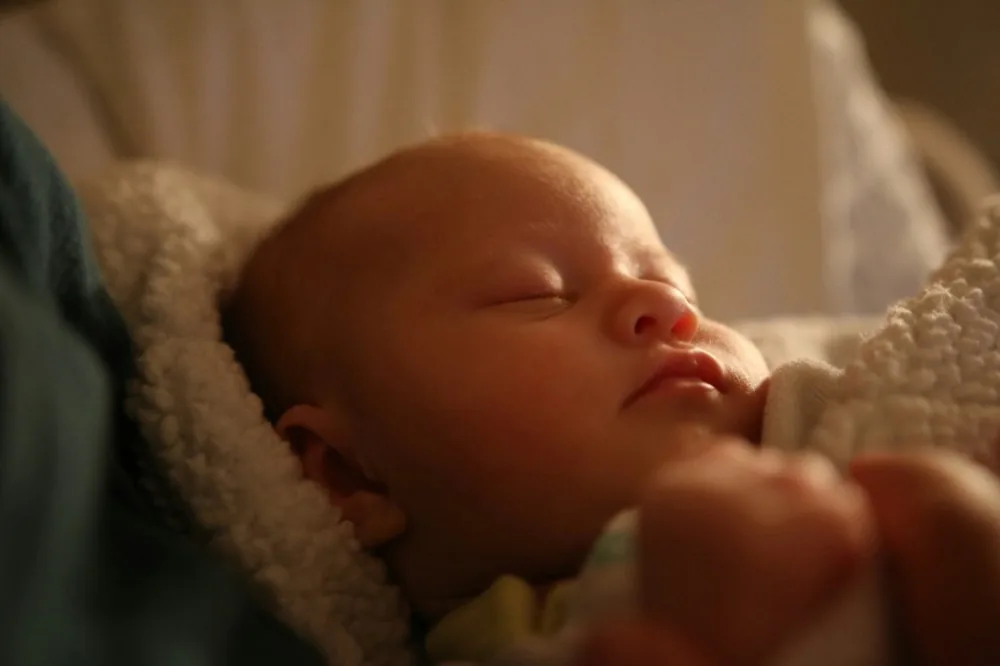
As your baby grows, their sleep pattern changes: they take fewer naps, stay awake for longer, and nighttime sleep usually becomes longer and more predictable.
Age-based recommendations can be a helpful guide, but every baby develops their own rhythm. Each day does not need to match the table exactly.


sprouty
Sleep, feeding, and milestones in one app



Look at your baby’s sleep over several days rather than judging it by a single day.
How Much Sleep Does a Child Need?
Total sleep includes all sleep in a 24-hour period: both nighttime sleep and naps.
Sleep changes especially quickly during the first few months, so the recommendations for babies under 3 months are shown in more detail.
| Age | Total sleep per day | Nighttime sleep | Naps |
|---|---|---|---|
| 0–7 weeks | 14–17 hours | 8–11 hours | 4–6 |
| 8 weeks | 14–16 hours | 8–10 hours | About 5 |
| 9–10 weeks | 14–16 hours | 8–10 hours | 4–5 |
| 11–12 weeks | 14–16 hours | 8–10 hours | 4–5 |
| 13 weeks | 13–16 hours | 8–10 hours | About 4 |
| 4–6 months | 12–16 hours | 10–12 hours | 3–4 |
| 7–9 months | 12–15 hours | 10–11 hours | 2–3 |
| 10–12 months | 12–14 hours | 10–12 hours | 2 |
| 13–18 months | 11–14 hours | 10–12 hours | 1–2 |
| 19–24 months | 11–14 hours | 10–12 hours | 1 |
| 24–36 months | 11–13 hours | 10–11 hours | 0–1 |
These are approximate ranges. On some days, your child may sleep a little more or less—for example, after a busy day, during an illness, or while learning new skills.
What to Know About Sleep at 2–3 Months
At this age, your baby’s internal body clock is still developing. Sleep can be uneven: your baby may fall asleep at roughly the same time one day, while their rhythm shifts noticeably the next.
Nighttime sleep often begins later than it does for older babies, and the difference between day and night may still be less clear. Naps can also vary in length and happen at different times.
That is why a sleep schedule at 2–3 months is best treated as a gentle guide. It can help you see a possible rhythm for the day without expecting every nap to happen at an exact time.
If your baby’s sleep still feels unpredictable, it does not necessarily mean that anything is wrong. During the first few months, a more regular rhythm is only beginning to develop.
How Long Can a Child Stay Awake Between Sleeps?
After waking, your baby needs time for feeding, connection, movement, and calm activity. The amount of time they can comfortably stay awake gradually increases with age.
| Age | Approximate awake time |
|---|---|
| 0–7 weeks | 45–90 minutes |
| 8 weeks | 60–80 minutes |
| 9–10 weeks | 60–85 minutes |
| 11–13 weeks | 60–90 minutes |
| 4–6 months | 1.5–2.5 hours |
| 7–9 months | 2–4 hours |
| 10–12 months | 2.5–4 hours |
| 13–18 months | 3.5–6 hours |
| 19–24 months | 5–6 hours |
| 24–36 months | 5–6 hours |
If your child stays awake for too long, they may become overtired. This can make it harder for them to settle and fall asleep, even when they are clearly sleepy.
You do not need to rely on the clock alone. Watch your baby too: lower activity, fussiness, losing interest in play, or wanting to be held may all be signs that it is time to rest.
When Does Nighttime Sleep Usually Begin?
During the first few weeks, there is often no clear difference between daytime and nighttime sleep. From around 2 months, nighttime sleep gradually begins to shift toward the evening, although it may still start quite late.
| Age | Approximate start of nighttime sleep |
|---|---|
| 0–7 weeks | A regular rhythm has not developed yet |
| 8 weeks | 8:30–10:30 pm |
| 9–10 weeks | 8:00–10:00 pm |
| 11–12 weeks | 7:30–9:30 pm |
| 13 weeks | 7:00–9:00 pm |
| 4–6 months | 7:00–9:00 pm |
| 7–9 months | 7:00–8:30 pm |
| 10–12 months | 7:00–8:30 pm |
| 13–18 months | 7:00–8:30 pm |
| 19–24 months | 7:30–8:30 pm |
| 24–36 months | 7:30–9:00 pm |
These times are approximate ranges, not deadlines by which your child must be asleep.
The start of nighttime sleep depends not only on age, but also on when the last nap ended and how long your child has been awake since then. If the last nap ends later than usual, bedtime may shift a little too.
Why Your Baby’s Rhythm May Differ from the Table
The ranges show how much most healthy children of a certain age usually sleep. One child may regularly sleep closer to the lower end, while another may sleep closer to the upper end. Both can be completely normal.
Sleep can temporarily change because of:
- illness or feeling unwell;
- teething;
- new skills and developmental changes;
- travel or a change of environment;
- an unusually active or quiet day;
- changes in the family’s usual routine.
Small changes in sleep during these periods are natural.
What Matters More Than the Numbers
Recommendations can help you find your bearings, but they do not show the full picture. It is more important to notice how your child feels throughout the day.
The rhythm usually suits your child if they:
- wake up in a generally good mood;
- move, play, and show interest in the world around them;
- eat as usual;
- do not seem tired all the time;
- feel comfortable for most of the day.
If your child regularly sleeps much less than the recommended range for their age, struggles to fall asleep, often seems overtired, or their sleep changes suddenly without a clear reason, talk to your pediatrician.
Every child gradually develops their own rhythm. You do not need to make every day perfect—a steady routine that feels comfortable for your family matters more than matching the table exactly.
With care
Our articles are based on evidence-based medicine and reviewed by pediatricians. However, they do not replace a consultation with your doctor. Every child is unique — if you have any concerns, please consult a medical professional.
sprouty
Sleep, feeding, and milestones in one app
Sources
- Paruthi, S., Brooks, L. J., D'Ambrosio, C., et al. (2016). Recommended Amount of Sleep for Pediatric Populations: A Consensus Statement of the American Academy of Sleep Medicine. Journal of Clinical Sleep Medicine, 12(6), 785–786. https://doi.org/10.5664/jcsm.5866
- Hirshkowitz, M., Whiton, K., Albert, S. M., et al. (2015). National Sleep Foundation's Sleep Time Duration Recommendations: Methodology and Results Summary. Sleep Health, 1(1), 40–43. https://doi.org/10.1016/j.sleh.2014.12.010
- Galland, B. C., Taylor, B. J., Elder, D. E., & Herbison, P. (2012). Normal Sleep Patterns in Infants and Children: A Systematic Review of Observational Studies. Sleep Medicine Reviews, 16(3), 213–222. https://doi.org/10.1016/j.smrv.2011.06.001
- World Health Organization. (2019). Guidelines on Physical Activity, Sedentary Behaviour and Sleep for Children Under 5 Years of Age. https://www.who.int/publications/i/item/9789241550536
- Bruni, O., Baumgartner, E., Sette, S., et al. (2014). Longitudinal Study of Sleep Behavior in Normal Infants During the First Year of Life. Journal of Clinical Sleep Medicine, 10(10), 1119–1127. https://doi.org/10.5664/jcsm.4114
- Iglowstein, I., Jenni, O. G., Molinari, L., & Largo, R. H. (2003). Sleep Duration From Infancy to Adolescence: Reference Values and Generational Trends. Pediatrics, 111(2), 302–307. https://doi.org/10.1542/peds.111.2.302
- Price, A. M. H., Brown, J. E., Bittman, M., et al. (2014). Children's Sleep Patterns From 0 to 9 Years: Australian Population Longitudinal Study. Archives of Disease in Childhood, 99(2), 119–125. https://doi.org/10.1136/archdischild-2013-304150
- Horváth, K., & Plunkett, K. (2018). Spotlight on Daytime Napping During Early Childhood. Nature and Science of Sleep, 10, 97–104. https://doi.org/10.2147/NSS.S126252
- Bathory, E., & Tomopoulos, S. (2017). Sleep Regulation, Physiology and Development, Sleep Duration and Patterns, and Sleep Hygiene in Infants, Toddlers, and Preschool-Age Children. Current Problems in Pediatric and Adolescent Health Care, 47(2), 29–42. https://doi.org/10.1016/j.cppeds.2016.12.001
- Adolph, K. E., & Franchak, J. M. (2017). The Development of Motor Behavior. Wiley Interdisciplinary Reviews: Cognitive Science, 8(1–2), e1430. https://doi.org/10.1002/wcs.1430