How to Train Fine Motor Skills
 Category Category | Motor activity |
|---|

Medically reviewed by pediatrician Alexandra Zglavosiy
Your baby is learning to grab, hold, and pass objects — building brain connections and coordination. Light toys, tummy time, clapping games, and simple routines can help. Even clumsy attempts matter: no need to rush — let your baby figure it out.


sprouty
Sleep, feeding, and milestones in one app



Quick takeaways
- Starting around 4 months, babies begin to intentionally reach for and grab objects — an important motor milestone.
- Light, safe toys help develop grip, coordination, and hand strength.
- Tummy time remains important, but now you can add games that involve bringing hands together.
- Even clumsy movements are valuable learning steps.
- Don’t rush to help — give your baby a chance to figure it out.
At this age, babies reach for toys with intent
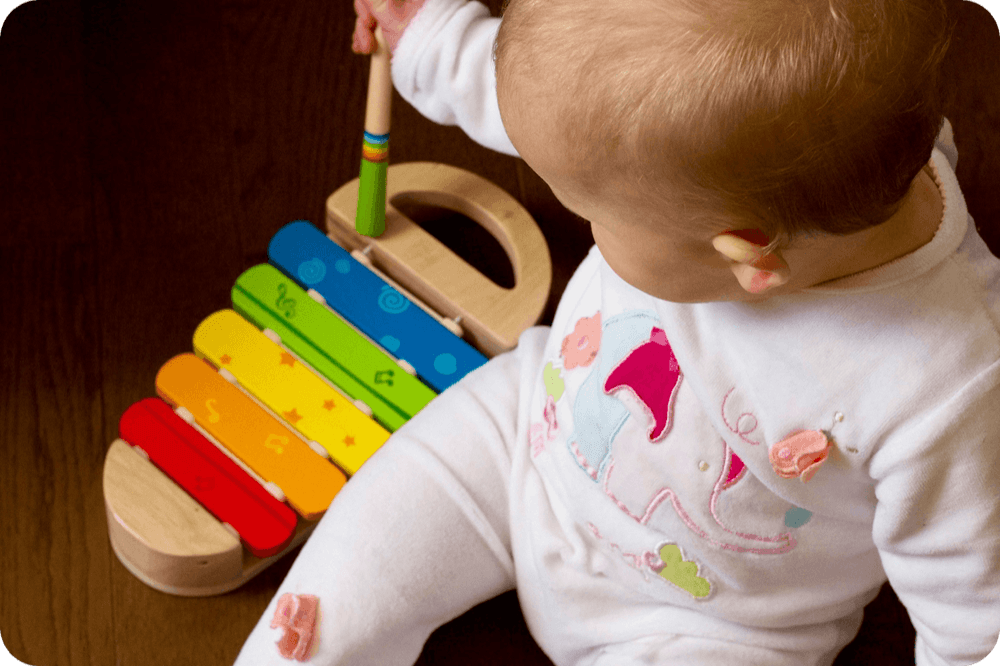
By 2–3 months, babies start to reach for toys. By 4 months, they do it intentionally and try to hold them. This is called the palmar grasp.
It’s a shift from reflexes to voluntary movement — brain and body begin working in sync.
Try offering:
- Toys with handles for easy gripping
- Bright, visible objects
- Safe toys to pull, shake, or chew
Light and textured toys help strengthen the grasp
Grabbing, shaking, or chewing toys builds hand-eye coordination and grip strength.
Useful options:
- Light teething toys
- Rattles with thin handles
- Soft toys with various textures
Toys should be easy to hold and free of small parts that could detach.
Babies begin passing toys from hand to hand
Around 5–6 months, babies may start transferring objects between hands — a big step in motor development.
Encourage this by:
- Offering two-hand-friendly toys
- Showing how to pass a toy
- Letting your baby explore, even awkwardly
Tummy time is still essential
- Tummy time strengthens shoulders, neck, and torso — all crucial for grasping and reaching.
- Do it 2–3 times a day.
- Place toys slightly to the side or in front of your baby.
- Make it playful and interactive.
Games where babies bring their hands together build coordination
Bringing hands to midline — holding toys with both hands or reaching for knees — supports bilateral coordination, which is key for tasks like buttoning or drawing.
Encourage this by:
- Offering toys at chest level
- Playing clapping games
- Letting baby explore their own hands and feet
Avoid stepping in too soon
- It’s tempting to help when a toy drops or your baby gets frustrated. But letting them try — and fail — is how they learn.
- Don’t adjust their grip right away.
- Don’t place toys directly in their hand.
- Offer smiles and encouragement instead.
Chewing, banging, and spinning are part of learning too
Actions like banging or chewing help babies explore object properties and cause-effect relationships.
Support this by:
- Letting them bang soft toys on the floor
- Narrating: “bang-bang!”
- Allowing safe oral exploration
FAQ about fine motor skills
When do babies start intentionally reaching for toys?
Usually, babies start intentionally reaching for toys around 4 months of age. At this stage, they move from reflex-based actions to voluntary control and mostly use a palmar grasp. Parents should offer light toys at chest level and allow the baby to reach independently. Avoid placing objects directly in the hand so coordination can develop naturally.
Which toys help develop fine motor skills?
It is recommended to use light and safe toys that are easy for babies to hold. Rattles, teethers, and objects with different textures are especially helpful because they encourage grasping and sensory exploration. Simple shapes without small detachable parts are best. These toys support hand strength, coordination, and early visual-motor integration.
Is it normal if a baby drops toys and seems clumsy?
Yes, this is completely normal. Dropping objects, adjusting grip, and awkward movements are part of learning control over hands. Through repetition, babies develop coordination and understand how objects behave. Parents should avoid intervening too quickly and allow the baby to try again independently to build confidence and motor learning.
How can parents help develop fine motor skills?
Parents can support development through simple daily play. Offer toys at chest level, play clapping games like "pat-a-cake," and encourage the baby to reach for objects independently. Tummy time is also important for strengthening shoulders and arms. Avoid placing toys directly in the baby's hand so natural exploration can develop.
With care
Our articles are based on evidence-based medicine and reviewed by pediatricians. However, they do not replace a consultation with your doctor. Every child is unique — if you have any concerns, please consult a medical professional.
sprouty
Sleep, feeding, and milestones in one app
Sources
- Adolph KE, Franchak JM. The development of motor behavior. Wiley Interdiscip Rev Cogn Sci. 2017 Jan;8(1-2):10.1002/wcs.1430. doi: 10.1002/wcs.1430. Epub 2016 Dec 1. PMID: 27906517; PMCID: PMC5182199. https://pubmed.ncbi.nlm.nih.gov/27906517/. Accessed 16 Apr. 2026.
- Haywood, K. M., & Getchell, N. (2014). Lifespan Motor Development (6th ed). Champaign, IL: Human Kinetics.
- Case-Smith, J. (2015). Occupational Therapy for Children and Adolescents, 8th Edition, December 26, 2016. eBook ISBN: 9780323512626
- Rochat P. Self-sitting and reaching in 5- to 8-month-old infants: the impact of posture and its development on early eye-hand coordination. J Mot Behav. 1992 Jun;24(2):210-20. doi: 10.1080/00222895.1992.9941616. PMID: 14977620. https://pubmed.ncbi.nlm.nih.gov/14977620/. Accessed 16 Apr. 2026.
- Hewitt L, Kerr E, Stanley RM, Okely AD. Tummy Time and Infant Health Outcomes: A Systematic Review. Pediatrics. 2020 Jun;145(6):e20192168. doi: 10.1542/peds.2019-2168. Epub 2020 May 5. PMID: 32371428. https://pubmed.ncbi.nlm.nih.gov/32371428/. Accessed 16 Apr. 2026.
- Thelen, E., & Smith, L. B. (1994). A dynamic systems approach to the development of cognition and action. The MIT Press.
- Barrett TM, Traupman E, Needham A. Infants' visual anticipation of object structure in grasp planning. Infant Behav Dev. 2008 Jan;31(1):1-9. doi: 10.1016/j.infbeh.2007.05.004. Epub 2007 Jul 12. PMID: 17624439. https://pubmed.ncbi.nlm.nih.gov/17624439/. Accessed 16 Apr. 2026.
- Berthier NE, Clifton RK, McCall DD, Robin DJ. Proximodistal structure of early reaching in human infants. Exp Brain Res. 1999 Aug;127(3):259-69. doi: 10.1007/s002210050795. PMID: 10452213. https://pubmed.ncbi.nlm.nih.gov/10452213/. Accessed 16 Apr. 2026.