The Baby Isn’t Crawling but Tries to Stand — Is That Normal?
 Category Category | Motor activity |
|---|

Medically reviewed by pediatrician and perinatal psychologist Polina Kizino
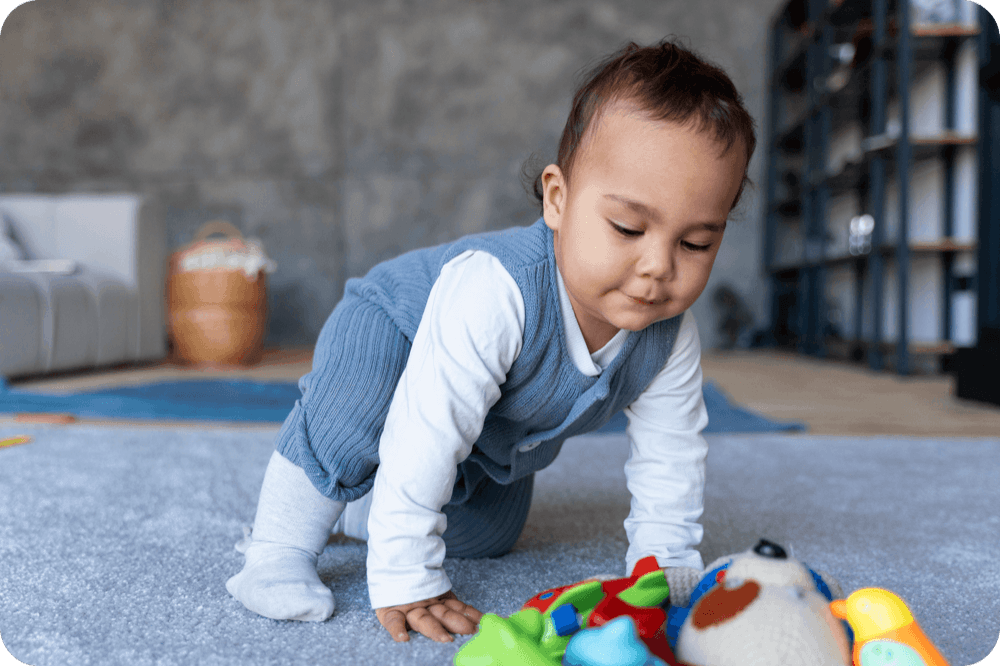
Crawling is important, but not essential. Some babies start standing before they crawl. If your baby is active, sits well, and bears weight on their legs, it’s often normal. Red flags include low energy, body asymmetry, or no interest in movement. Consult a pediatrician if you’re unsure.

sprouty
Sleep, feeding, and milestones in one app



Quick takeaways
- Crawling is important but not essential.
- Some babies start pulling up to stand before they crawl.
- If your baby is active, sits well, bears weight on their legs, and reaches upward — it’s usually normal.
- Warning signs include sluggishness, no desire to move or bear weight, and body asymmetry.
- If in doubt, consult a pediatrician or neurologist.
Why this happens
On average, babies begin crawling between 6 and 10 months. But it’s not a strict rule. Some babies:
- Move differently — for example, belly-crawling or scooting backward.
- Prefer to pull up to standing right away, skipping the crawling stage.
This may be due to individual factors: muscle tone, body structure, temperament, or home environment (like always seeing upright adults, which motivates standing).
Important: if a child is developing well overall — sitting, bearing weight, interacting — the absence of classic crawling isn’t cause for worries.
When to be concerned
While not crawling isn’t always a problem, it can signal motor delays or tone issues. Consult a specialist if:
- By 9–10 months, the baby isn’t crawling or trying to stand.
- They can’t sit without support.
- They don’t push up with arms or bear weight on legs.
- They use only one side of the body (e.g., always reaching with the same hand).
- Movements are very asymmetrical or the baby seems sluggish.
Tip: if you're unsure, it’s best to talk to a pediatrician or child neurologist. They’ll assess motor skills (e.g., GMFCS or AIMS scales) and advise whether monitoring or support is needed
What you can do at home
To support natural development:
- Create a safe space for free movement.
- Use motivating toys — place them just out of reach.
- Let your baby explore the floor; avoid jumpers and walkers.
- Play on the floor to encourage arm and leg movement.
- Support their attempts to stand — provide a steady surface and stay close.
Frequently Asked Questions About a Baby Who Doesn't Crawl but Tries to Stand
Is it normal if a baby does not crawl but tries to stand?
Yes, this can be a normal variation. Some babies start pulling up to stand before they crawl, and this is not considered a developmental problem. At 9–10 months, many babies actively try to stand and move along furniture. What matters most is that the baby is active and gradually developing new motor skills.
Why does the baby try to stand instead of crawling?
This is often related to individual development differences. Some babies skip classic crawling and move directly to standing. This depends on muscle tone, body structure, temperament, and environment. If the baby is active and tries to pull up, this is usually a normal variation.
When can lack of crawling be a concern?
You should consult a doctor if by 9–10 months the baby does not crawl or attempt to stand, cannot sit without support, does not bear weight on legs, or uses only one side of the body. Low activity or lack of interest in movement can also be warning signs.
What can parents do to support development?
Provide a safe floor space and allow free movement. Place toys slightly out of reach to encourage movement. Support standing attempts and avoid devices that limit movement such as walkers or jumpers. Regular floor play helps natural motor development.
With care
Our articles are based on evidence-based medicine and reviewed by pediatricians. However, they do not replace a consultation with your doctor. Every child is unique — if you have any concerns, please consult a medical professional.
sprouty
Sleep, feeding, and milestones in one app
Sources
- and de Onis, M. (2006), WHO Motor Development Study: Windows of achievement for six gross motor development milestones. Acta Pædiatrica, 95: 86-95. https://doi.org/10.1111/j.1651-2227.2006.tb02379.x. Accessed 7 May 2026.
- Adolph, K.E. and Tamis-LeMonda, C.S. (2014), The Costs and Benefits of Development: The Transition From Crawling to Walking. Child Dev Perspect, 8: 187-192. https://doi.org/10.1111/cdep.12085. Accessed 7 May 2026.
- CDC’s Developmental Milestones, U.S. Centers for disease control and prevention, https://www.cdc.gov/ncbddd/actearly/milestones/index.html. Accessed 7 May 2026.
- Darrah J, Redfern L, Maguire TO, Beaulne AP, Watt J. Intra-individual stability of rate of gross motor development in full-term infants. Early Hum Dev. 1998 Sep;52(2):169-79. doi: 10.1016/s0378-3782(98)00028-0. PMID: 9783818. https://pubmed.ncbi.nlm.nih.gov/9783818/. Accessed 7 May 2026.
- Patrick SK, Noah JA, Yang JF. Interlimb coordination in human crawling reveals similarities in development and neural control with quadrupeds. J Neurophysiol. 2009 Feb;101(2):603-13. doi: 10.1152/jn.91125.2008. Epub 2008 Nov 26. PMID: 19036860; PMCID: PMC2657078. https://pubmed.ncbi.nlm.nih.gov/19036860/. Accessed 7 May 2026.
- Thelen E. Motor development. A new synthesis. Am Psychol. 1995 Feb;50(2):79-95. doi: 10.1037//0003-066x.50.2.79. PMID: 7879990. https://pubmed.ncbi.nlm.nih.gov/7879990/. Accessed 7 May 2026.