The Benefits of a Ball and How to Play with It
 Category Category | Motor activity |
|---|

Medically reviewed by pediatrician and perinatal psychologist Polina Kizino
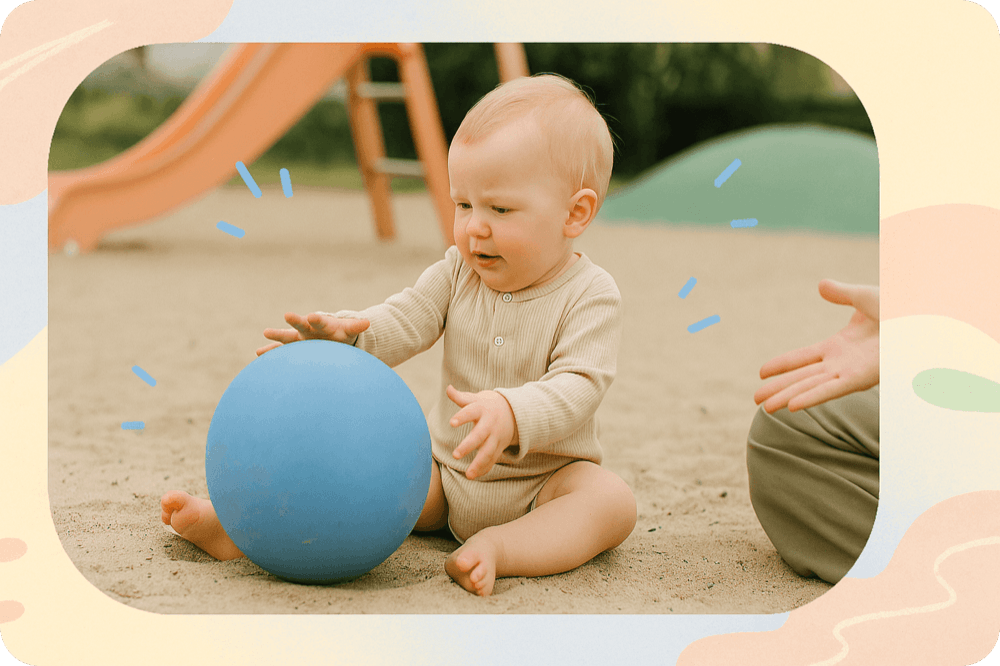
Playing ball together teaches your baby communication. It also boosts coordination, builds strength, and brings joy through movement. A ball helps children understand cause-and-effect relationships: “hit it — it rolls.”


sprouty
Sleep, feeding, and milestones in one app



Quick takeaways
- Ball games train hand-eye coordination, agility, and balance.
- Playing with a ball together develops speech, social skills, and early forms of interaction.
- A ball helps children understand cause-and-effect relationships: “hit it — it rolls.”
- Rolling and throwing a ball strengthen core muscles and improve movement coordination.
- For a one-year-old, choose lightweight, soft balls — safer and more engaging.
A Ball Develops Coordination and Balance
When a baby reaches for the ball, tries to hold it, rolls it, or throws it, they train eye-hand coordination. These movements strengthen core muscles, promote balance, and improve body control.
Ball Play Is the First Step Toward Dialogue
By rolling a ball back and forth with an adult, a child learns to wait, make eye contact, and understand pauses and the rhythm of communication. Such games lay the foundation for future social and emotional interaction.
Supports Speech Development
During play, the adult accompanies actions with words: “roll,” “catch,” “where’s the ball?” This helps the child connect words to actions and gradually memorize them.
Teaches Cause-and-Effect Relationships
When a child notices the ball rolls after being thrown, they begin to grasp basic logic: “If I do A, B happens.” This is a crucial stage of cognitive development.
Creates a Positive Movement Experience
Ball games bring joy and pleasure from movement. This motivates the child to repeat actions, boosting motor skills and self-confidence.
Ball Game Ideas for 1-Year-Olds
- Roll the ball on the floor: Sit facing the child and roll the ball to each other.
- Knock down a tower of blocks: Let the toddler throw the ball to “destroy” the tower.
- Find the ball: Hide the ball behind a pillow and ask the child to find it.
- Tummy-time ball play: Encourage the child to reach for the ball while lying on their tummy.
- Pass the ball in a circle: Play with family members, passing the ball one by one.
Ball Safety Tips
- Choose soft, lightweight balls without small parts.
- Ensure the child doesn’t put the ball in their mouth.
- Play on the floor, away from sharp corners and stairs.
- Never leave a child unsupervised with a ball.
Frequently asked questions about playing with a ball
When can you start playing with a ball?
Simple ball games can usually start around 8 months of age. At this stage, babies can reach for the ball, track its movement, and begin rolling it on the floor. These early interactions help develop attention, visual tracking, and the first intentional motor responses, which are important for later physical development.
What are the benefits of ball games for babies?
Ball games help develop coordination, balance, and body control. Babies strengthen their core muscles and improve overall motor activity while learning to coordinate visual input with physical movement. This combination supports early brain development and lays the foundation for more complex physical skills such as crawling, standing, and walking.
How do you play ball with a baby under one year?
You can start by rolling the ball back and forth on the floor, encouraging the baby to reach for it or find it behind objects. Simple hide-and-seek games with the ball also work well. During play, it is important to constantly name actions like "roll" or "catch" to connect language with movement.
Why do ball games support speech and communication development?
Ball games naturally support communication because they create turn-taking interactions between adult and child. The baby learns to wait, watch, and respond to actions. Repeated words paired with actions help the child associate language with real experiences, which supports early speech comprehension and the foundations of dialogue.
With care
Our articles are based on evidence-based medicine and reviewed by pediatricians. However, they do not replace a consultation with your doctor. Every child is unique — if you have any concerns, please consult a medical professional.
sprouty
Sleep, feeding, and milestones in one app
Sources
- Needham, A. (2000). Improvements in object exploration skills may facilitate the development of object segregation in early infancy. Journal of Cognition and Development, 1(2), 131–156. https://doi.org/10.1207/S15327647JCD010201. Accessed 6 May 2026.
- Adolph KE, Franchak JM. The development of motor behavior. Wiley Interdiscip Rev Cogn Sci. 2017 Jan;8(1-2):10.1002/wcs.1430. doi: 10.1002/wcs.1430. Epub 2016 Dec 1. PMID: 27906517; PMCID: PMC5182199. https://pubmed.ncbi.nlm.nih.gov/27906517/. Accessed 6 May 2026.
- Rachwani J, Santamaria V, Saavedra SL, Woollacott MH. The development of trunk control and its relation to reaching in infancy: a longitudinal study. Front Hum Neurosci. 2015 Feb 24;9:94. doi: 10.3389/fnhum.2015.00094. Erratum in: Front Hum Neurosci. 2015 Jul 21;9:406. doi: 10.3389/fnhum.2015.00406. PMID: 25759646; PMCID: PMC4338766. https://pubmed.ncbi.nlm.nih.gov/25759646/. Accessed 6 May 2026.
- Tomasello, M. (2003). Constructing a language: A usage-based theory of language acquisition. Harvard University Press. https://psycnet.apa.org/record/2003-00574-000. Accessed 6 May 2026.
- Baillargeon, R. (2004). Infants' physical world. Current Directions in Psychological Science, 13(3), 89–94. https://doi.org/10.1111/j.0963-7214.2004.00281.x. Accessed 6 May 2026.
- Thompson RA. Development in the first years of life. Future Child. 2001 Spring-Summer;11(1):20-33. PMID: 11712453. https://pubmed.ncbi.nlm.nih.gov/11712453/. Accessed 6 May 2026.