How to Give Your Baby Freedom
 Category Category | Physiology |
|---|

Medically reviewed by pediatrician and perinatal psychologist Polina Kizino
Giving your baby freedom means letting them crawl, choose a toy, or hold a spoon. This kind of independence in everyday actions builds confidence, motor skills, and initiative. The key is not to rush — stay close and let them try.


sprouty
Sleep, feeding, and milestones in one app



Quick takeaways
- Freedom gives babies a sense of “I can,” builds confidence and motivation.
- The child learns to act independently — with safety and parental presence.
- Don’t intervene too early — let them try first.
- Offering a choice is also freedom: two toys instead of one.
- Free movement matters more than structured “activities”.
- Don’t rush or restrict unnecessarily.
- Too much control can slow down natural development.
What’s happening with your baby
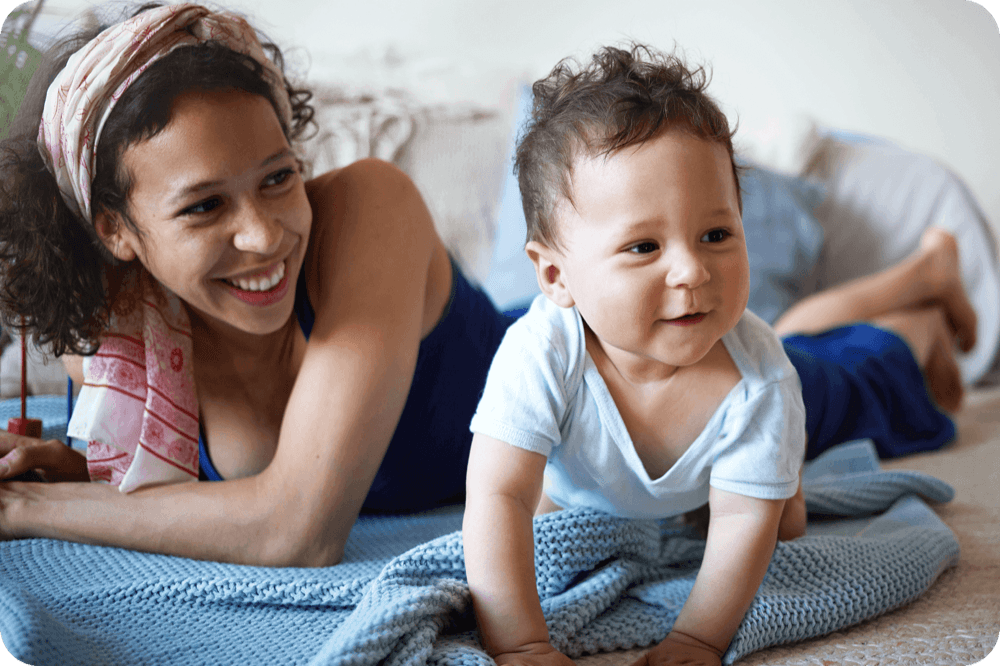
At this stage, babies explore actively. They reach, crawl, pull up, try to move — and they check in with you: is it okay? is it safe? is my parent nearby?
This is not just about motor skills, but about a growing sense of self. Your baby is starting to understand they are their own person — and wants to influence things, like picking a toy or deciding where to go.
Why freedom is important now
In the early months, babies need constant physical closeness. But by 9–12 months, early signs of self-regulation and internal motivation appear.
Psychologists say freedom isn’t about “doing whatever you want” — it’s the chance to try, make mistakes, create. That’s how confidence and resilience grow.
Even in infancy, babies learn best when they explore on their own, not just when shown “the right way”
Ways to offer freedom in daily life
Freedom to move
Let your baby crawl, stand, walk — in a safe and adapted space. Avoid using walkers or holding them too much: even short moments of free movement matter more than formal exercises.
If they can’t get out of a position on their own — it’s not development, it’s restriction.
Freedom to choose
Choosing between two toys, books, or paths helps build decision-making. Even small choices make your child a participant, not just a follower.
Instead of: “Take the car,” try: “Do you want the ball or the car?”
Freedom to act — with support
Wants to put on a hat? Let them try. Holding the spoon? That’s great.
Allow independence, even if it’s slow or messy. Your job is to be nearby, not to do it for them.
“But what if my baby is too young?”
Worrying is natural. But you’re not leaving your child alone — you’re creating safe conditions for action.
Your support means:
- Adapted space
- Stable chairs and non-slip floors
- Warm encouragement
- Observation, not control
Your baby picks up your emotions: if you believe in them, they’ll believe in themselves.
“What if my baby resists independence or gets fussy?”
That’s normal too. Freedom is not a requirement — it’s an opportunity. Your baby will come back to it when they feel safe.
The more you respond to their needs, the more confident they’ll feel to step out and try things on their own.
FAQs about giving your baby freedom
At what age should babies be given more freedom?
Usually, babies benefit from more freedom between 9 and 12 months of age. At this stage they actively crawl, pull up, choose toys, and begin acting independently. Early self-regulation, initiative, and confidence develop during this period. Stay nearby, prepare a safe environment, and give your baby a chance to try before stepping in to help.
Why is it good for babies to try doing things on their own?
Yes, independent attempts support healthy development. Reaching for a toy, holding a spoon, or trying to put on a hat strengthens motor skills, confidence, and intrinsic motivation. Allow your baby to experiment and make mistakes instead of doing every task for them. Your role is to encourage, observe, and provide help only when it is truly needed.
How can I safely give my baby more freedom?
It's best to create a safe space for independent exploration. Let your baby crawl, stand, and move freely without unnecessary restrictions. Offer simple choices, such as between two toys or books, avoid walkers, and stay close for support instead of constant control. Safe exploration helps babies learn through their own experience.
What if my baby resists independence or becomes fussy?
Yes, this is completely normal. Freedom is an opportunity, not a requirement, and babies often return to trying new things once they feel secure again. Continue responding warmly to your baby's needs, provide encouragement, and maintain a safe environment. Feeling supported helps children become more confident about acting independently over time.
With care
Our articles are based on evidence-based medicine and reviewed by pediatricians. However, they do not replace a consultation with your doctor. Every child is unique — if you have any concerns, please consult a medical professional.
sprouty
Sleep, feeding, and milestones in one app
Sources
- Gopnik A. Childhood as a solution to explore-exploit tensions. Philos Trans R Soc Lond B Biol Sci. 2020 Jul 20;375(1803):20190502. doi: 10.1098/rstb.2019.0502. Epub 2020 Jun 1. PMID: 32475327; PMCID: PMC7293160. https://pubmed.ncbi.nlm.nih.gov/32475327/. Accessed 7 May 2026.
- Kochanska G, Koenig JL, Barry RA, Kim S, Yoon JE. Children's conscience during toddler and preschool years, moral self, and a competent, adaptive developmental trajectory. Dev Psychol. 2010 Sep;46(5):1320-1332. doi: 10.1037/a0020381. PMID: 20822241; PMCID: PMC3495080. https://pmc.ncbi.nlm.nih.gov/articles/PMC3495080/. Accessed 7 May 2026.
- Feinman, S., Roberts, D., Hsieh, KF., Sawyer, D., Swanson, D. (1992). A Critical Review of Social Referencing in Infancy. In: Feinman, S. (eds) Social Referencing and the Social Construction of Reality in Infancy. Springer, Boston, MA. https://doi.org/10.1007/978-1-4899-2462-9_2. Accessed 7 May 2026.
- Karreman, A., van Tuijl, C., van Aken, M.A.G. and Deković, M. (2006), Parenting and self-regulation in preschoolers: a meta-analysis. Inf. Child Develop., 15: 561-579. https://doi.org/10.1002/icd.478. Accessed 7 May 2026.
- 12-month-old infants allocate increased neural resources to stimuli associated with negative adult emotion, By Carver, Leslie J.,Vaccaro, Brenda G., Developmental Psychology, Vol 43(1), Jan 2007, 54-69, https://psycnet.apa.org/buy/2006-23020-005. Accessed 7 May 2026.
- Campos JJ, Mumme DL, Kermoian R, Campos RG. A functionalist perspective on the nature of emotion. Monogr Soc Res Child Dev. 1994;59(2-3):284-303. PMID: 7984165. https://pubmed.ncbi.nlm.nih.gov/7984165/. Accessed 7 May 2026.
- Winnicott, D. W. (1965). The maturational processes and the facilitating environment: Studies in the theory of emotional development. International Universities Press. https://psycnet.apa.org/record/1966-02652-000. Accessed 7 May 2026.
- Deci, E. L., & Ryan, R. M. (2000). The "what" and "why" of goal pursuits: Human needs and the self-determination of behavior. Psychological Inquiry, 11(4), 227–268. https://doi.org/10.1207/S15327965PLI1104_01. Accessed 7 May 2026.
- van IJzendoorn MH, Hubbard FO. Are infant crying and maternal responsiveness during the first year related to infant-mother attachment at 15 months? Attach Hum Dev. 2000 Dec;2(3):371-91. doi: 10.1080/14616730010001596. PMID: 11708224. https://pubmed.ncbi.nlm.nih.gov/11708224/. Accessed 7 May 2026.
- Rheingold, H. L. (1982). Little Children’s Participation in the Work of Adults, a Nascent Prosocial Behavior. Child Development, 53(1), 114–125. https://doi.org/10.2307/1129643. Accessed 7 May 2026.