Is It Normal for a Baby to Lose Hair?
 Category Category | Physiology |
|---|

Medically reviewed by pediatrician Alexandra Zglavosiy
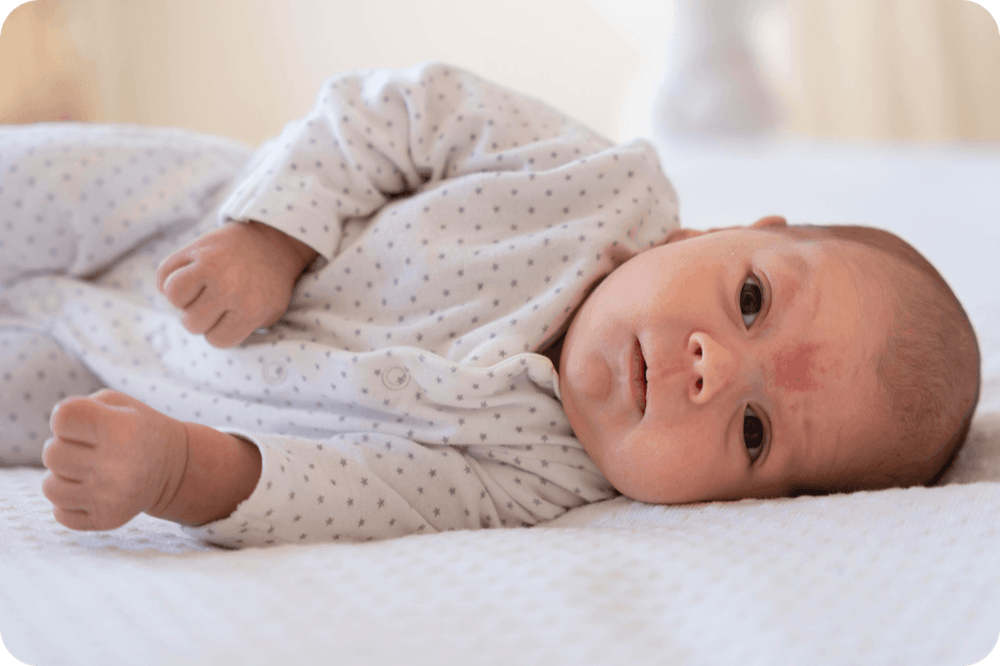
Hair loss in babies is normal. In the first few months, hair often thins due to hormonal changes after birth, and new hair typically starts growing around 6 months. To help prevent bald spots, change your baby’s sleep position regularly and choose lightweight hats. See a doctor if there’s redness, flaking, itching, or if hair doesn’t grow back after age one.

sprouty
Sleep, feeding, and milestones in one app



Quick takeaways
- Hair loss is normal. Most babies lose some hair in the first 3–6 months due to a drop in maternal hormones after birth. New hair usually starts to grow between 6–12 months and may be darker or thicker.
- Warning signs: round bald spots with clear edges, redness, flaking or itching of the scalp, or if hair doesn’t grow back after one year. In these cases, consult your pediatrician.
- To prevent bald spots: change your baby’s position during sleep and play more often, and choose loose hats made from breathable fabrics.
Why do babies lose hair
Hair loss in infants is linked to hormonal changes. While in the womb, a baby has high hormone levels, which promote active hair growth. After birth, hormone levels drop, and some hair falls out, making way for new, stronger hair.
- First signs of hair loss can appear as early as 1–2 months old.
- By 3–6 months, hair loss may be most noticeable-some babies develop bald spots, especially on the back of the head.
- After 6 months, new hair begins to grow, which may differ in color and texture from the hair at birth.
How to care for your baby’s hair
- Use gentle baby shampoos without harsh surfactants or fragrances.
- Don’t wash your baby’s hair too often-2–3 times a week is enough.
- Massage the head gently to improve blood flow.
- Use soft brushes with natural bristles to avoid damaging delicate hair.
- Avoid tight hats-they can reduce blood flow to the scalp.
When to see a pediatrician
In most cases, newborn hair loss is temporary and doesn’t need treatment. New fuzz or full hair will grow back on its own.
But see your pediatrician if:
- Hair loss is accompanied by redness, flaking, rashes, or itching-this may be a sign of a skin condition.
- Hair falls out unevenly, forming round bald spots-this could be due to a fungal infection or autoimmune process (like alopecia).
- Hair loss continues after one year and new hair does not grow in.
Frequently asked questions about baby hair loss
Is it normal for a newborn to lose hair?
Yes, it is normal. Hair loss in newborns is a common physiological process caused by hormonal changes after birth. It often begins around 1–2 months of age, becomes most noticeable at 3–6 months, and usually does not require treatment. New hair typically starts growing within the first year of life.
At what age do babies most often lose hair?
Most commonly it happens at 1–2 months of age and becomes more noticeable between 3–6 months. This is due to normal hormonal shifts after birth as maternal hormones decrease. After 6 months, new hair begins to grow, and by the end of the first year its texture may become thicker or different in appearance.
When should I see a doctor for baby hair loss?
See a doctor if hair loss is accompanied by warning signs. These include redness, flaking, itching, or the appearance of round or uneven bald patches. You should also consult a pediatrician if hair does not begin to regrow after 12 months or if shedding becomes more severe over time. A medical evaluation can help rule out skin or fungal conditions.
How should I care for my baby's hair and scalp?
Usually, gentle care and simple hygiene habits are enough. Use mild baby shampoo 2–3 times a week and avoid over-washing. Change your baby's head position regularly during sleep and play to reduce pressure on the same area. Avoid tight hats and friction on the scalp, as these can contribute to temporary hair thinning.
With care
Our articles are based on evidence-based medicine and reviewed by pediatricians. However, they do not replace a consultation with your doctor. Every child is unique — if you have any concerns, please consult a medical professional.
sprouty
Sleep, feeding, and milestones in one app
Sources
- Kim MS, Na CH, Choi H, Shin BS. Prevalence and factors associated with neonatal occipital alopecia: a retrospective study. Ann Dermatol. 2011 Aug;23(3):288-92. doi: 10.5021/ad.2011.23.3.288. Epub 2011 Aug 6. PMID: 21909197; PMCID: PMC3162256. https://pmc.ncbi.nlm.nih.gov/articles/PMC3162256/. Accessed 1 Apr. 2026.
- “Hair Loss”, Seattle’s Children’s, https://www.seattlechildrens.org/conditions/a-z/hair-loss/. Accessed 1 Apr. 2026.
- “Hair Loss (Alopecia) in Children”, American Academy of Pediatrics, https://www.healthychildren.org/English/health-issues/conditions/skin/Pages/Hair-Loss-Alopecia.aspx. Accessed 1 Apr. 2026.
- Cutrone M, Grimalt R. Transient neonatal hair loss: a common transient neonatal dermatosis. Eur J Pediatr. 2005 Oct;164(10):630-2. doi: 10.1007/s00431-005-1707-y. Epub 2005 Jul 12. PMID: 16010567. https://pubmed.ncbi.nlm.nih.gov/16010567/. Accessed 1 Apr. 2026.
- Cohen BA. Pediatric Dermatology. 4th Edition, 2013. ISBN: 9780723436553
- Newborn hair loss, Babycenter, https://www.babycenter.com/health/conditions/hair-loss-in-babies_85. Accessed 8 Apr. 2026.