How to Choose Safe Toys for Babies Up to 6 Months
 Category Category | Nursery and objects |
|---|

Medically reviewed by pediatrician and perinatal psychologist Polina Kizino
Safety is the top priority when choosing toys for babies under 6 months. Avoid small parts, strong smells, and sharp edges. Look for “0+” labels and choose toys made of safe, easy-to-clean materials.

sprouty
Sleep, feeding, and milestones in one app


Quick takeaways
- Safety is the main criterion: toys shouldn’t have small parts, toxic materials, or sharp edges. Check for “0+” age labeling and trusted safety marks (e.g. CE in Europe, ASTM in the US).
- Suitable toys for 0–6 months: soft teething toys, textured rattles, crib mobiles with soft elements, rubber bath toys without holes (to avoid mold).
- Avoid toys that smell strong, have loosely attached parts, or are marked “Not for children” — unsafe and untested.
- Choose BPA-free plastic, silicone, food-grade rubber. Toys must be easy to clean and not trap dirt.
- After 6 months: you can add stacking rings, sorter toys, button toys — but make sure parts are still large.
Safety first
Babies explore the world with their senses, and toys support sensory and coordination development. Safety is top priority:
- No small parts that could be swallowed
- Made of non‑toxic, baby‑safe materials
- Easy to clean, dirt‑resistant
- Smooth surfaces with no sharp edges or small components
Toys should spark curiosity
For babies under 6 months, choose toys that stimulate senses and motor skills:
- Soft toys and teethers: gentle on gums, easy to grasp, safe to put in mouth, often textured to massage the gums.
- Texturedand sound toys: rattles or squeezable toys with mild sounds to develop hearing and attention; bright textures help visual stimulation.
- Crib mobiles: visually engaging, sometimes musical elements that support visual tracking and soothe.
- Rubber bath toys: safe for water play — no small parts, easy to clean. Avoid toys with holes that trap water and mold.
- Grip balls and rings: colorful, easy to hold, promote grasp reflex and coordination.
Materials, parts, weight, durability, and maintenance
- Check materials: choose eco‑safe materials (BPA‑free, no phthalates, lead‑free). Look for “0+ months” and “Child‑safe” labels.
- Inspect small parts: ensure nothing can detach, no sharp pieces.
- Test durability: babies will pull, bite, and drop toys — parts must be secured.
- Cleanliness: toys must be washable and not collect water or dirt inside.
- Weight: choose lightweight toys to prevent injury if dropped during lifting.
Safe toys have certificates
Toys for babies should not only be fun but have a "safety passport." Here's what to look for:
- “0+” label. Guarantees size, materials, and design are suitable for newborns.
- Recognized safety marks – for example, ASTM F963 in the US. These marks confirm compliance with regional toy safety standards.
- Ask for certification. Sellers should provide safety documentation. If not — better choose another brand.
- Trust but verify. Even with marks, inspect toys: pull parts, smell for strong odors (a red flag!), check weight.
- Avoid toys marked “Not a toy for children” — they aren’t safety-tested.
After 6 months
As babies start sitting and using hands more, standard toys become less interesting. Choose:
- Construction toys: stacking blocks, pyramids
- Moving-part toys: wheeled cars, toys with buttons
- Sorting toys: to refine motor skills
You can also introduce toys from “older age” sections, but safety must always come first.
Frequently Asked Questions About Safe Toys for Babies Under 6 Months
What toys are suitable for babies under 6 months?
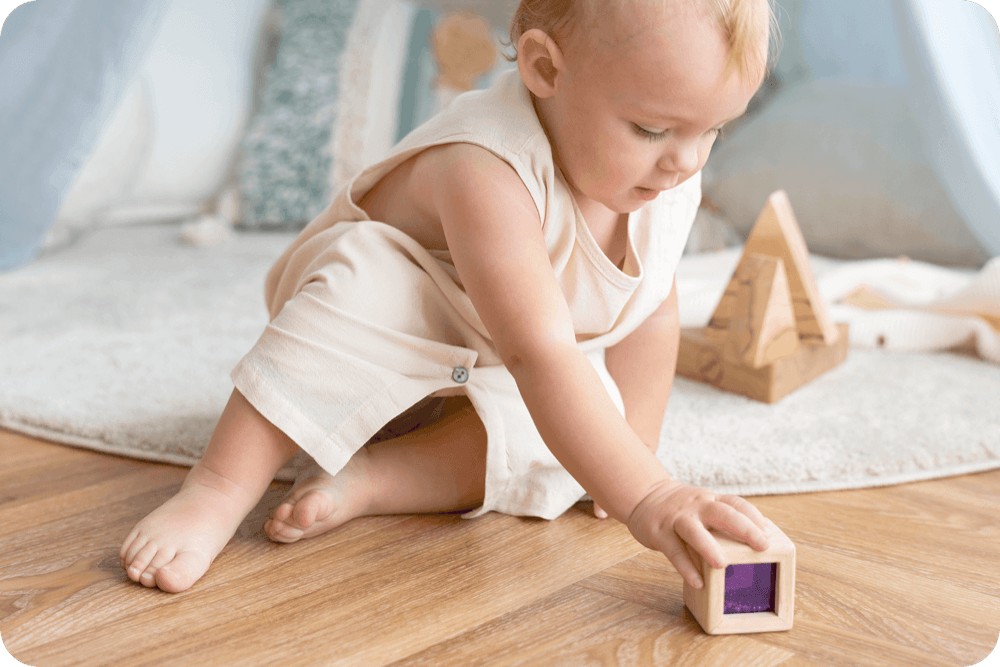
Usually, babies under 6 months can use soft teethers, textured rattles, crib mobiles with soft elements, easy-to-grip balls and rings, and safe bath toys. These toys support vision, hearing, touch, attention, and movement coordination. The key is to choose “0+” age labeling and materials that are easy to wash.
How can I tell if a toy is safe for an infant?
A safe toy has “0+” age labeling, safety certification, and no small parts, sharp edges, or toxic materials. It should be large enough, lightweight, sturdy, and easy to clean. Before buying, pull on parts, check the smell and weight: a strong chemical odor or loose elements are reasons to choose another toy.
What should I look for when choosing baby toys?
Check the material, size, weight, durability, and ease of cleaning. The toy should be lightweight, large enough that it cannot be swallowed, and strong enough to handle chewing, grabbing, and pulling. Choose BPA-free plastic, silicone, or food-grade rubber, and avoid designs with holes where water or dirt can collect.
Why are toys with small parts, strong smells, or holes dangerous?
It is better to avoid them because small parts can be swallowed, sharp elements can injure the skin, and a strong smell may suggest unsafe materials. Bath toys with holes are also not ideal: water can get trapped inside, they are hard to dry fully, and mold may develop over time.
With care
Our articles are based on evidence-based medicine and reviewed by pediatricians. However, they do not replace a consultation with your doctor. Every child is unique — if you have any concerns, please consult a medical professional.
sprouty
Sleep, feeding, and milestones in one app
Sources
- Wolfe, C. D., & Bell, M. A. (2017). The integration of cognition and emotion during infancy. Infant Behavior and Development, 49, 54–61. https://doi.org/10.1016/j.infbeh.2017.07.009
- Memon, A., Ali, S., & Waseem, M. (2019). Hazards of Unsafe Infant Toys: A Pediatric Perspective. Journal of Pediatric Health Care, 33(6), 715–722. https://doi.org/10.1016/j.pedhc.2019.05.004
- U.S. Consumer Product Safety Commission (2021). Toy Safety Report. https://www.cpsc.gov
- National Safe Kids Campaign. (2016). Toy Injury Data and Prevention Guide.
- Vandell, D. L., & Wilson, K. S. (1987). Infants’ social behavior in response to toys and people. Child Development, 58(4), 1128–1136. https://doi.org/10.2307/1130557
- American Academy of Pediatrics. (2022). Toy Safety Guidelines. https://www.healthychildren.org